It is worth repeating every so often, for those who don’t know: for thirty years now, for one week in July, Bologna is the world’s centre for cinephiles.
And so a few days after the end of the festival in 2016 we asked head of the educational department of the Cineteca di Bologna – Elisa Giovannelli, 4 questions. Her job is to manage educational plans for the public of all ages, such as Schermi e Lavagne she is responsible for and spokesperson, which she has done in the past.
Let’s begin with a classic question. 30 years of the festival and 100 thousand people to celebrate with you: Have you survived the Cinema Ritrovato of 2016? What’s the image that you will never forget from such a special edition?
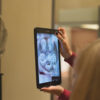
Yes, I’ve survived: it’s a very lovely but very challenging time of the year. We in the education department, have been working throughout the festival for the first time, not only in the children’s section (screenings and workshops every afternoon) but, also, with activities for high school kids. We had the “Ambassadors” with us, kids from 4 different schools (3 in Bologna and 1, by chance, from Monza which is my home town) involved in the European Project ABCinema, also by alternating school-work. At the end of the 2016 edition I will take home with me the smile and the enthusiasm of the young people who continue to ask us to do things together!
We at BAM! came to have a sneak peek at the international workshop on audience development organized by Europa Cinemas, intrigued by the subtitle: “The cinematic experience in the age of digital distractions.” How do you think European cinema is facing these inevitable distractions? Does it avoid it or go with it?
The topic is hotly debated, even at regulatory level. The European Commission, for example, is making specific public competitions for distribution platforms, which are not traditional distributors, but digital platforms, on demand. The message is “listen up, there is a world here that you can not ignore.” Even for us, education is a challenge but at the same time, an opportunity: when we teach the history of film we can now use other means, other channels and other formats, without having to depend on VHS or DVD: We cannot ignore that learning today happens through other channels.
Then there’s the tendency is to make the cinematic experience as comfortable as possible and provide alternatives to the film: operas, videogames, documentaries about artists, large-scale concerts or events … We try to make the cinema a place of learning and enjoyment even beyond the film. Obviously there are those who resist and don’t want anything to do with it and then there’s those who instead jump in head first: the digital world now has given us the possibility of multi-programming previously unthinkable (even with four or five screenings a day), with results sometimes with a difficult identity or communication … but there is no doubt that the opportunities offered by new technology are also central for those involved in education.
Can you explain to us a bit better who are the “Ambassadors” born with the European project ABCinema are? How were the kids involved and how are they related to the objectives of the project?
The Ambassador experience was born in the second year of ABCinema, when we decided to put into practice an idea that we had had for a long time: to work with a group of people with whom to co-curate and that then could promote our content in the public circles it has contact with. Essentially, a group of ambassadors.
The “recruitment process” was carried out using a traditional educational process in two high schools in Bologna: Enrico Fermi and Laura Bassi. Those who were interested in the classes emerged immediately. Then, with the Liceo Minghetti we started a process of alternating school and work, first on the history of cinema, starting with from film projections getting to work on the content of the films.. The result was the production of short clips that presented them, made by them with our supervision. Also on this occasion, at the end, all those who were most interested stayed continued to work with us.
By the end, a group of 10 people had been formed, who have carried out projects during the festival (interviews, videos, documentaries) and dialogued with other Ambassadors of different ages from ours, sent by another partner from the European project from Germany, Holland, France and Belgium. This was nice as it gave us a chance to exchange of skills and approaches.
They understood that the goal was not to write a good post on Facebook but confront the work done by others.
To conclude, tell us the “best practice” of the most interesting, innovative, or funny film audience involvement that you have recently seen put into practice?
There are two. The Watershed is a cinema and cultural centre that has been ABCinema’s partner f and that for many many years has been working with children between 16 and 25 working on co-programming and direct involvement in the activities and competitions. Minifilmclub of the Deutsches Film Institute of Frankfurt, is a project with nursery schools involving children in several meetings in the film library and engages them in activities that puts them in contact with the general public, such as guided visits done by children for children. Once they were familiar with the place, the experts acted as guides to newcomers.