A reflection stemming from the event celebrating ten years of the Associazione Abbonamento Musei in Lombardy

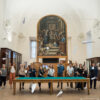
Tuesday 17 May, at the Museo Nazionale Scienza e Tecnologia Leonardo da Vinci in Milan, “Oltre la soglia: la sfida della partecipazione” (Beyond the Threshold: the challenge of engagement) took place. This was a meeting promoted by the Associazione Abbonamento Musei in partnership with BAM! Strategie Culturali.
Active since 1998 in Piedmont and since 2015 in Lombardy, Abbonamento Musei celebrated the tenth anniversary of its Lombardy project with a lively discussion involving institutions, museums and cultural professionals on the theme of cultural engagement.
Engagement means constructing communities around culture
“Ours is, first and foremost, a community that loves cultural experiences,” said Alberto Garlandini, President of the Associazione Abbonamento Musei. It is from this vision that the project in Lombardy has flourished – from an initial 84 participating museums to over 230, with around 57,000 members. Fiorenzo Galli, Director of the Museo Nazionale Scienza e Tecnologia Leonardo da Vinci, emphasises that participation goes beyond museum visitors; it also encompasses the entire network of stakeholders, partners and organisations working collaboratively to ensure the institution remains a space for dialogue between humanistic and scientific culture.
Behind the numbers lies the understanding that cultural engagement is not measured solely by ticket sales, but by the ability to cultivate lasting relationships with diverse audiences, to create shared experiences and to become an integral part of the communities that use museums.
As Lorenza Gazzero of Fondazione Cariplo observed, the transformative potential of network projects such as Abbonamento Musei lies precisely in their systemic nature: connecting institutions, regions and professionals, while valuing each one’s unique characteristics. Throughout the day, several factors that hinder full and informed cultural engagement were explored: informational, physical, economic and social barriers, which are numerous and often deeply interconnected.
Information and mediation for better accessibility
We addressed two different types of barriers during two roundtable discussions. The first roundtable, moderated by BAM!’s Federico Borreani, focused on “barriers to information and understanding”. There is now widespread awareness that museum communication must be designed from the outset as an integral part of the experience, but many challenges remain. We need to rethink the information system, strengthen cultural mediation and diversify languages. In other words, we need to start with audiences, their needs and their stories.
Experiences such as that of the Museo delle Storie di Bergamo – as told by its scientific director Roberta Frigeni – demonstrate the extent to which digital technology can become an invaluable ally. From the geolocalised platform “Open Your Museum” to the podcast along the UNESCO World Heritage Walls, the museum becomes an active presence in the local area, a fluid space where heritage intertwines with people’s lives.
One of the central themes was the role of networks, explored in depth with Elisa Monsellato from the Reti Museali di Puglia. Among the key opportunities identified are the engagement of new audiences, the development of new skills and enhanced accessibility to museums on multiple levels. This is echoed by the experience of the Fondazione Luigi Rovati, under the direction of Monica Loffredo, which – through the concept of the “gentle museum” – pursues an inclusive approach rooted in ongoing experimentation with communication, accessibility and collaboration with other institutions. Tools such as LIS video guides, tactile tours and initiatives like “Museo per tutti” reflect a tangible and sustained commitment.
Pricing policies, affordability and engagement as a right
The second roundtable, moderated by Simona Ricci of Abbonamento Musei, turned the spotlight on “economic barriers”. Subscription schemes, combined tickets, discounts and free admission days are crucial tools for broadening access to culture. However, they must be accompanied by a long-term strategy capable of promoting loyalty and inclusion.
An illustrative example is the strategy of Fondazione Brescia Musei, presented by Francesca Belli, Coordinator of Communications, Marketing and Fundraising. In 2025, the foundation introduced a single annual ticket with the aim of creating a scattered museum experience, where the city itself becomes an integral part of the cultural journey between the various museum sites. Among the initiatives implemented is free admission for residents, reflecting the vision of culture as a universal right and a public service.
Public policy also plays a crucial role in this context. As Roberto Vannata of the Directorate-General for Museums at the Ministry of Culture highlighted, the development of membership schemes and the digital integration of Italian museums (through apps and unified ticketing systems) serve as important tools for breaking down access barriers. Francesco Spano of Federculture subsequently reinforced the call to recognise culture as a fundamental human right, advocating for measures such as tax exemptions to support this principle. The aim is to encourage legislators to introduce a single, standard VAT rate for all cultural goods, be it a concert, a book or museum entry. Investing in cultural participation means recognising culture as nourishment for the mind and a vital instrument for social cohesion.


A threshold to cross together
“Oltre la soglia” was an opportunity to reflect on participation as an ongoing process – one that moves beyond self-referential approaches and towards the co-creation of cultural policies grounded in listening, care and meaningful collaboration.
Find out more about our role in the event by reading the article on our website.
Learn about other occasions when we have spoken about engagement:
- “How do you see it?” Participation and co-design in Asola
- Co-design for promoting shared heritage
- Working with the community to imagine the Eastern Gothic Line ecomuseum of the future
The text of this article has a Gulpease index of 45.8, meaning that it has an average-to-high level of reading difficulty and comprehension, consistent with the type of audience for which it was written (professionals in the cultural heritage sector).
The Gulpease index is a very useful tool for evaluating the readability of a text in Italian. Find out more on our Accessibility page.