Three days in Berlin with cultural professionals to discuss cultural engagement among young people
From 21 to 23 May 2025, the fifth biennial “Connected Audience Conference 2025” was held at the Theater Strahl in Berlin, organised by the independent research institute IKTf [Institut für Kulturelle Teilhabeforschung], together with an international network of partners.
An intensive programme with plenty to choose from: 9 parallel sessions, 14 workshops, plenary meetings and almost 80 speakers from 17 different countries. All centred around the question: how can we make cultural engagement among young people more authentic, effective and sustainable?
Here are three ideas that resonated with us and that we want to take home with us.
1. There is no such thing as “young people”
It is a conceptual and strategic mistake to talk about young people as a single category.
How often have we seen, read or heard the words engagement, young people and culture used together, as though they were an inseparable trio? The cultural engagement of young people has become a recurring theme, almost a catchphrase, featured ever more prominently in the discourse of cultural institutions. For years – perhaps always – there has been talk of the desire to involve “young people”, often viewed as the conspicuous absentees among audiences, visitors and participants in cultural programmes.
But does it really make sense to talk about “young people” as if they were a single, homogeneous block? Who are these “young people” really? This is where the conference began: with the keynote speech “There is no such thing as ‘THE’ Young People”, which challenged the often generic and oversimplified perception of youth, highlighting the urgent need to acknowledge the diversity and complexity behind that seemingly straightforward concept. To genuinely engage younger generations, it is essential to get to know them, listen to them and understand their specific characteristics by employing audience analysis tools and ongoing target segmentation.
Segmentation does not mean pigeonholing; rather, it involves recognising that groups evolve and change, along with their associated cultural codes. A one-off analysis is insufficient. What’s needed is a dynamic, ongoing approach

2. Engagement = shared power
From engagement rhetoric to co-governance.
Through talks, presentations and workshops, we explored a wide range of case studies that challenge the traditional sender–receiver dynamic. When discussing shared experiences, whether participatory or co-design processes, it is vital to consider decision-making structures, hierarchies and institutional missions. “Genuine” participation is made possible through models of co-governance and collaborative design.
We are trying to explore this concept further through some insightful examples: experiences such as Takeover Festival in Baden-Baden, where young curators work alongside artists and institutions to develop a festival with shared responsibilities on every level, or Deutsche Oper am Rhein’s UFO – Junge Oper Urban, which transports opera outside its traditional spaces into local neighbourhoods.
Another emblematic example is Be Resilient at the National Gallery of Ireland, where a group of young people aged between 16 and 25 established a participatory board that has, over time, evolved into an open and flexible process with no fixed time limits.
Simply being open to listening and opening the doors of museums, libraries and theatres is no longer sufficient, as it does not automatically equate to sharing power. Transparency in processes and a sincere commitment to sharing power with younger generations, moving beyond tokenism* and mere performativity, are essential to demonstrating genuine trust and investment in them.
*tokenism can be considered a sort of veiled discrimination. Wikipedia defines this term as making a perfunctory and symbolic effort towards the equitable inclusion of members of a minority group, especially by recruiting people from under-represented social-minority groups in order for the organization to give the public appearance of racial and gender equality

3. Beyond figures
Cultural organisations and institutions must, therefore, shift away from pursuing abstract and often “superficial” objectives, and instead focus on creating genuine value for young audiences by actively supporting their interests and needs.
This is the only way to transform “one shot” initiatives into enduring, structural relationships. But how can such impact be measured? What truly determines the success of a participatory process?
Perhaps it is time to move beyond merely counting participation numbers and begin telling stories differently. What truly matters is the quality of engagement and the longevity (its sustainability over time) of the connection with young people. The focus should be on the mechanisms and approaches that nurture that relationship. What counts is the willingness to engage on both sides and to collaborate in new ways, learning and unlearning from existing projects.
Are we, as institutions and individuals, truly prepared to transform ourselves – our objectives, processes and planning – and to be transformed by the young people we seek to include?
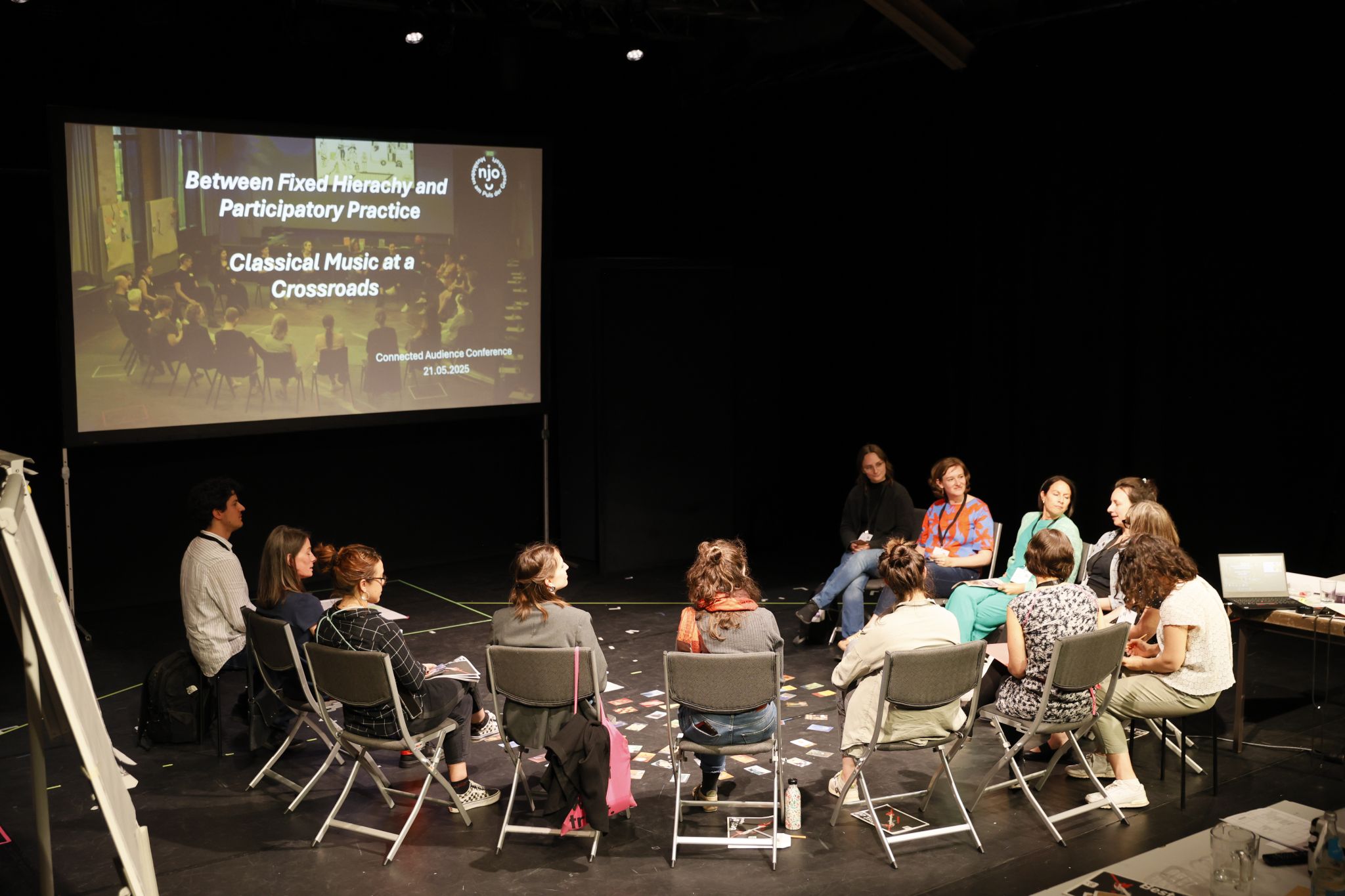
Who’s in the room?
The three days in Berlin offered us the opportunity to learn about international contexts presented objectively, highlighting both the successes and challenges of working with younger generations. This fostered a space for genuine discussion, leaving us with fresh questions, ideas and inspiration.
We leave with a provocative question posed during the plenary session: who’s in the room when this conversation happens? This fundamental query invites us to reflect on our internal processes, our teams and our planning decisions.
Photo credits: IKTf/Janosch Weiss